
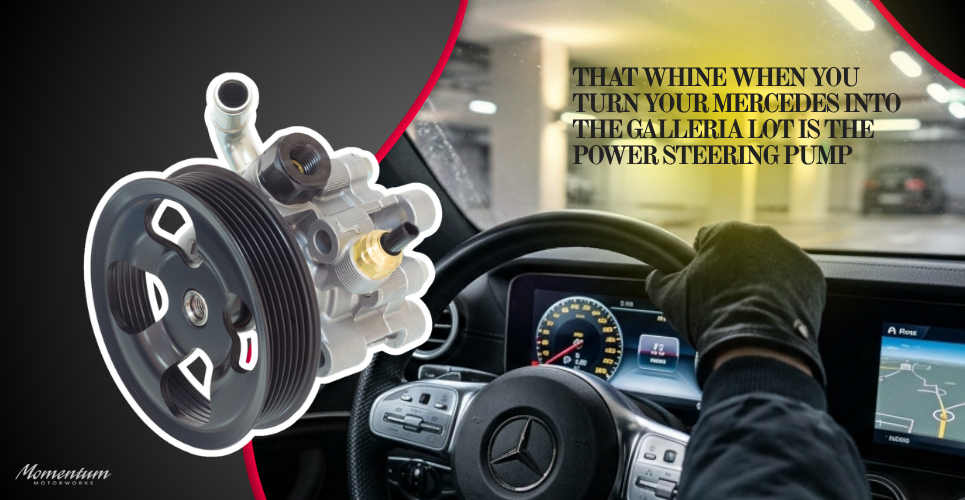
You hear it before you see it. Crank the wheel into a parking space off Old Montgomery Highway and the engine bay answers with a rising groan that tracks the steering wheel. It is worst first thing in the morning, now that the temperature has dropped.
On the hydraulic Mercedes models we work on in Birmingham — C-Class, E-Class, GLK and the older ML — that noise is the power steering pump telling you it is short of fluid, short of life, or both. It is a small repair caught early. It is a pump, a rack contamination flush and a bad afternoon caught late.
Quick Summary: Key Takeaways
- The noise follows the wheel: A whine or groan that rises when you turn and quiets when you straighten is hydraulic, not engine.
- Most pumps die thirsty: The pump itself rarely fails first. A leak drops the fluid level, the pump pulls air, and the air destroys it.
- Find the leak’s color: Mercedes power steering fluid is dyed, so look for a red or amber film on the pump nose, the reservoir seam and the lines.
- Cold mornings expose it: Thick fluid on a 45-degree morning makes a marginal pump audible weeks before it would be in July.
- Use the right fluid: These systems are specific about what goes in them, and the wrong fluid attacks the seals in the rack as well as the pump.
The pump only lasts as long as its fluid supply does
A belt-driven vane pump pressurizes fluid, the rack uses that pressure to help you steer, and the fluid returns to the reservoir to cool. Closed loop. It works quietly for years, provided it stays full and clean.
Air is the enemy. Once the level drops below the pickup, the pump draws air with the fluid, the mixture foams, and foam does not lubricate — so the vanes and the housing wear against each other every time you turn the wheel. That is the whine you hear.
Which is why a pump replacement without finding the leak is money wasted. The new pump inherits the same low fluid level and dies the same way.
Three leak points account for most of what we find
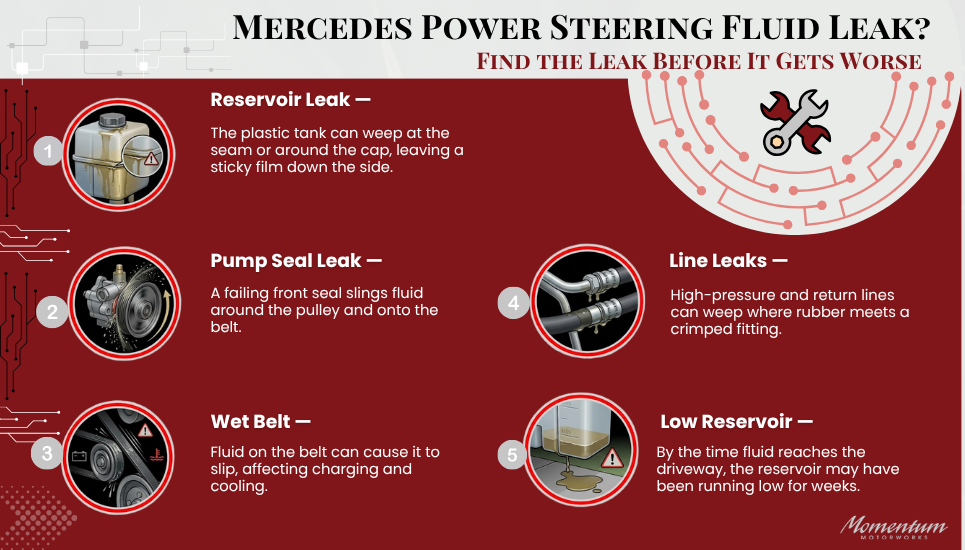
Start at the reservoir. The plastic tank weeps at the seam or around the cap on plenty of these cars, and you will find a sticky film down the side of it long before a single drop reaches the driveway.
Next is the pump’s front seal. That one shows up as fluid slung around the pulley and onto the belt, and a wet belt is worth catching fast, because a belt that slips takes charging and cooling with it.
Third are the high-pressure and return lines, particularly where a rubber section meets a crimped fitting. Heat cycling hardens the rubber, the crimp starts weeping, and by the time you see a spot on the driveway the reservoir has been running low for weeks.
Birmingham traffic is what makes a hydraulic system work hardest
Low-speed turning is the hardest thing you ask of the pump. Maximum pressure, minimum cooling. Parking decks, drive-throughs and the crawl on and off I-459 at rush hour are the worst of it.
There is a lot of that. The typical U.S. driver lost 43 hours to traffic congestion in 2024 according to ASCE’s 2025 roads report, and stop-and-go miles between Hoover, Homewood and Vestavia are exactly the miles that heat this system up.
Rough pavement adds to the load. ASCE’s Alabama report card lists 23% of the state’s roads as being in poor or fair condition, and every impact through the front wheels works the steering linkage and the rack seals.
Ignore the whine and the repair grows
A pump that has been running on foamy fluid does not fail politely. It sheds metal, and that debris circulates through the high-pressure line and into the steering rack, where it scores the valve body and the seals. Now you are replacing a rack as well.
The other outcome is worse. Lose fluid entirely and the steering goes heavy without warning, usually at the exact moment you need assist most, which is a slow-speed maneuver in traffic.
Neither outcome is expensive to prevent. Both are expensive to fix.
How we diagnose it before quoting a pump
We check level and fluid condition first, because dark, burnt or foamy fluid tells us a great deal on its own, and then we run the engine and listen with the wheel at rest and at lock while watching the reservoir for aeration. Clean fluid and a quiet pump at lock? The noise is coming from somewhere else.
Then the car goes on the lift with a bright light on the pump, reservoir, lines and rack boots, because finding the actual leak is the whole job. Five of our seven technicians are certified master techs, we work only on Mercedes, BMW and Audi, and we use OEM parts and the fluid the system was designed around.
Frequently Asked Questions
Q: Why does my Mercedes whine when I turn the steering wheel?
A: Air in the hydraulic system, nearly always caused by a low fluid level from a leak. The pump pulls air with the fluid, the mixture foams, and the pump gets noisy. Topping it up quiets things briefly, but the leak is still there and the pump is already wearing.
Q: How much does a Mercedes power steering pump replacement cost?
A: It depends on which model and whether the rack has been contaminated. A pump and a flush caught early is a contained repair; a pump plus a scored rack is a different conversation. We quote after we find the leak, not before.
Q: Can I just add power steering fluid?
A: As a short-term measure to protect the pump, yes, provided you use the correct specification for your model. But a system that needs topping up has a leak, and the wrong fluid will swell or shrink the seals in both the pump and the rack.
Q: Is heavy steering always the pump?
A: No. Heavy steering can come from a failing pump, a restricted line, a worn rack or, on the newer electric-assist cars, an electrical fault. That is why we test pressure and check the fluid before recommending any part.
Get the whine looked at while it is still just a noise
Cool mornings make this fault easy to hear, which makes October the cheap month to fix it. Bring the car to Old Montgomery Highway, tell us when the noise is loudest, and we will find where the fluid is going.
Hours: Mon-Fri 7:30 AM to 5:00 PM; closed Saturday and Sunday
Website: momentummotorworks.com