
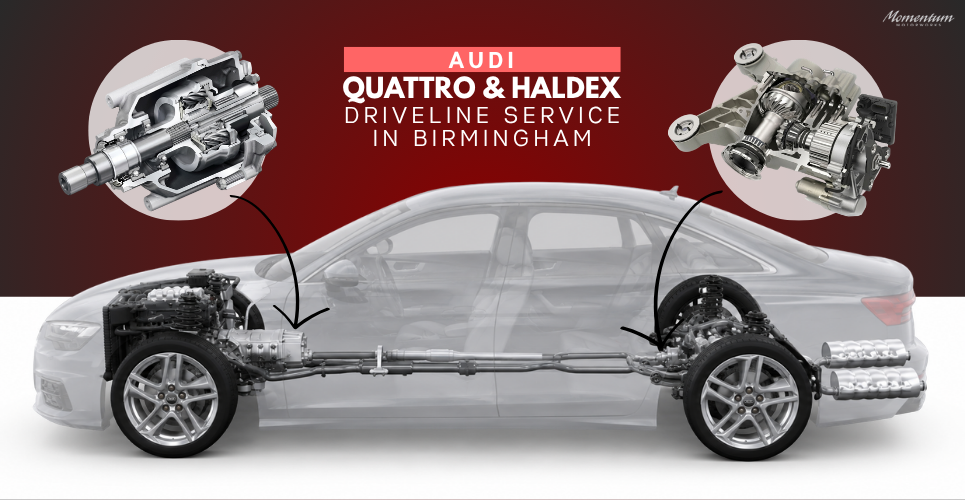
Your Q3 shudders through a tight turn in the Galleria parking deck. Or the A4 flashes an ESP warning on the ramp to I-459. Both complaints point at the driveline. Which system your Audi uses decides the whole repair.
Tires matter more than owners expect, and the U.S. Department of Energy notes that proper tire pressure improves gas mileage by about 0.6% on average, which is the same discipline that keeps four rolling diameters matched.
Quick Summary: Key Takeaways
- Two systems share one badge: A4, A5, A6 and Q5 use a center differential; A3, TT and Q3 use Haldex.
- Haldex needs fluid and a filter: Plan on service every 40,000 miles despite the lifetime label.
- Replace tires in fours: Keep tread within about 4/32 inch across all four corners.
- Binding in slow tight turns is a symptom: Look at the driveline. Not the transmission.
- Rear final drive fluid is not lifetime: On hard-driven cars we change it at 40,000 miles.
Audi builds two all-wheel-drive systems, and they fail in different ways
Know which one you have before spending a dollar on parts, because longitudinal cars, meaning A4, A5, A6, Q5 and their S variants, use a mechanical center differential. No electronics involved.
Transverse cars sit on the Golf platform family, so the front axle does the work and a Haldex unit at the rear differential sends torque back when the front tires slip. A3, S3, TT and Q3 all work that way. Same platform, different hardware.
One system is gears and oil. The other is hydraulics, a pump, a filter and a control module that can fail without a warning light, and confusing them wastes diagnostic hours.
Haldex units fail from neglected fluid and a clogged filter
The most common Haldex failure we see is a blocked filter starving the pump, because the fluid collects clutch material steadily over 60,000 or 80,000 miles until the screen gives up. Then pressure falls.
The rear axle simply stops receiving torque, and plenty of drivers never see a warning light at all because nothing electrical has actually broken. They notice the front tires spinning out of a wet Homewood driveway.
Most blame the tires. Fluid and filter service is cheap insurance, because replacing a failed Haldex pump costs several times what the service would have. We put it on a 40,000-mile schedule.
Center differential and driveline wear shows up as binding and vibration
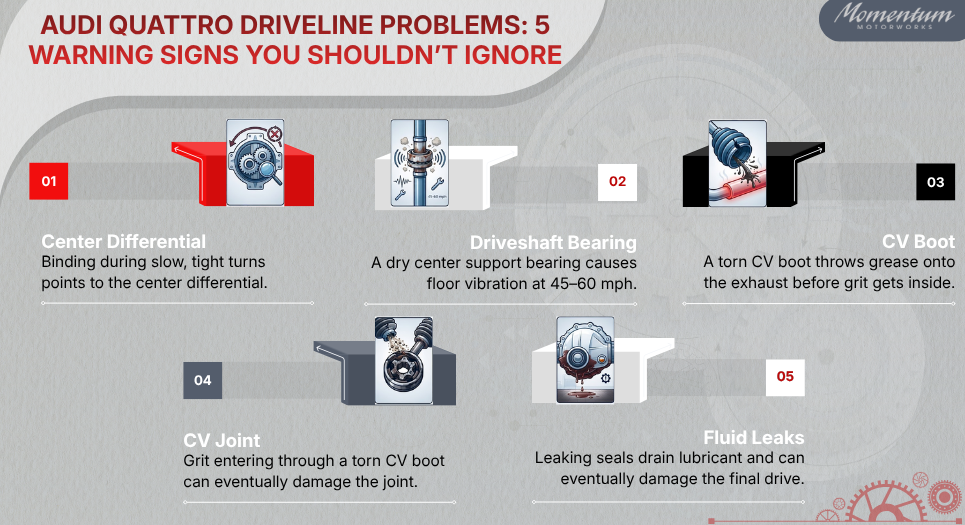
On longitudinal quattro cars the classic complaint is binding during slow, tight maneuvers, and backing out of an angled parking spot is where owners notice it first. That is the center differential.
The other wear items live in the driveshaft, where a dry center support bearing produces a vibration through the floor between 45 and 60 mph. A torn CV boot throws grease onto the exhaust first. Then grit gets in.
The joint dies a few thousand miles later. Leaks count too, since a weeping transfer case seal or pinion seal drains the lubricant that keeps a final drive alive. Low fluid there fails loudly.
Mismatched tires are the fastest way to destroy an Audi driveline
This is the mistake that costs Audi owners the most money, since replacing two tires instead of four leaves different rolling circumferences on the same car. The driveline absorbs that difference.
A Haldex clutch pack slips continuously to make up the speed error, generating heat and shedding friction material into fluid that was already working hard. A longitudinal center differential carries a constant preload instead.
No warranty covers that wear. Keep all four tires within roughly 4/32 inch of tread depth, same brand, same model, same size. Shaving a newer pair works if you must.
Our Birmingham shop services Audi drivelines with factory procedures
We start on the scan tool, reading the all-wheel-drive module for faults while the wheels turn on the lift, then road test the car with your exact complaint in mind. Focus helps here.
Our techs work only on Audi, BMW and Mercedes, so a Haldex service means dropping the fluid, replacing the pump filter, cleaning the screen and confirming pressure afterward. Refilling to spec with the correct Audi fluid is not optional. Every time.
We measure your tires as well. If tread depths are off enough to load the driveline, we say so before quoting the mechanical repair. Fixing a part while leaving the cause is not a repair.
Frequently Asked Questions
Q: How often should Haldex fluid and filter be changed on an Audi?
A: About every 40,000 miles. Audi calls the filter on later generations a lifetime part, but the fluid picks up clutch material and the screen blocks. A fluid and filter service is one of the cheapest ways to protect rear drive.
Q: Why does my Audi quattro shudder when turning at low speed?
A: Simple geometry. Slow tight turns are when front and rear axles rotate at the most different speeds, which loads the center differential hardest. Shudder there usually means worn clutch material, degraded fluid or mismatched tire diameters, and a road test paired with a module scan sorts out which one it is.
Q: Do I have to replace all four tires on an Audi quattro?
A: We strongly recommend it. Different rolling diameters force the driveline to absorb a permanent speed difference. If two tires are nearly new, a shop can sometimes shave the pair to match, but four matching tires is simpler and safer.
Q: What are the symptoms of a failed Haldex pump?
A: Loss of rear drive is the main one. The car behaves like a front-wheel-drive vehicle, spinning its front tires on wet pavement or gravel. Some cars store a low pressure code, and many show no warning light at all.
Schedule an Audi driveline inspection in Birmingham
Do not guess. If your Audi binds in tight turns or has lost grip in the wet, book an appointment and describe exactly when you feel it. We will scan the module, road test and check tire match.
Momentum Motorworks – 2075 Old Montgomery Hwy, Birmingham, AL 35244
Hours: Mon-Fri 7:30 AM to 5:00 PM; closed Saturday and Sunday
Website: momentummotorworks.com