
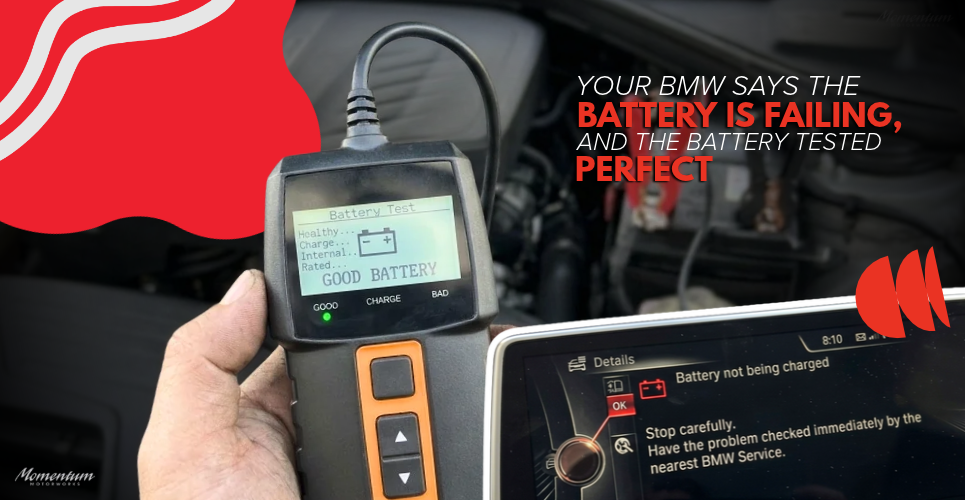
Owners turn up at the shop holding a printout from a parts store. Battery good, cold cranking amps on target, charging voltage normal. The car still shows a charging system message, the start-stop function has given up, and the engine takes a little longer to catch on cool Alabama mornings than it did in September.
Nothing in that picture is contradictory. On a modern BMW the battery and the car’s opinion of the battery are two different things, and they are allowed to disagree.
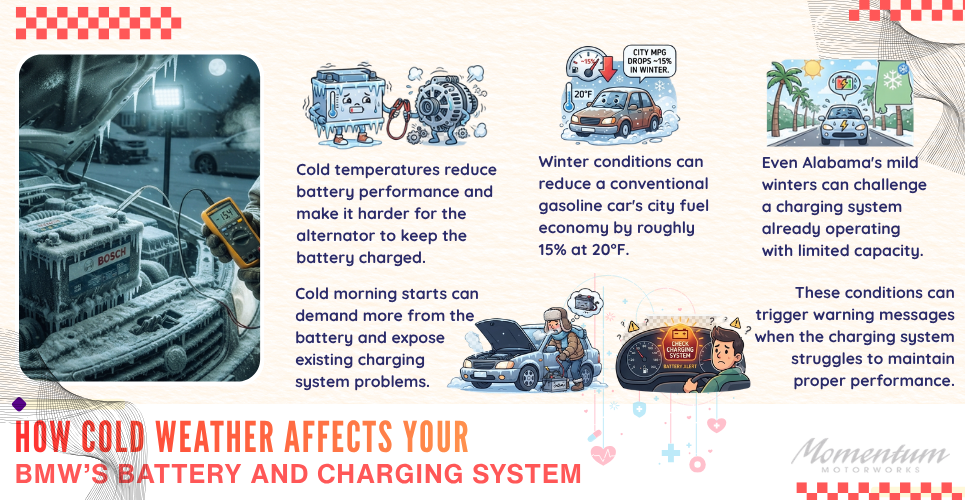
Cold mornings and the charging system pull against each other
The Department of Energy is blunt about what winter does to a 12-volt system. Battery performance drops in the cold, and that makes it harder for the alternator to keep the battery charged. The same guidance prices the season in fuel, putting a conventional gasoline car’s city mileage roughly 15% lower at 20°F than it would be at 77°F.
Alabama does not get Minnesota winters and does not need to. A charging strategy already working from bad numbers has no margin left when a December start asks a little more of the battery than a September one did. That week is usually when the message appears.
The sensor nobody knows is there
Look at the negative battery post on most BMWs built in the last fifteen years and you will find a small plastic module clamped around the cable. That module is the intelligent battery sensor, usually shortened to IBS. It measures current flowing in and out, terminal voltage and battery temperature, then sends all three to the engine and body modules over a single data wire.
Those modules use its data to set charging voltage, decide whether start-stop is allowed, shed electrical load when the battery is weak, and estimate remaining capacity. Every one of those decisions is only as good as the sensor feeding it.
A bad sensor reading drives the whole charging strategy
An IBS reporting current that is not flowing leaves the car calculating a battery that is draining. One that under-reports lets the alternator run at a reduced voltage and genuinely undercharge the battery over months.
Typical symptoms run in a recognizable set: a battery or charging message that returns after clearing, start-stop permanently unavailable, comfort functions disabled after the car sits, and a stored fault for implausible battery data. The battery itself tests fine throughout, because there is nothing wrong with it yet.
That last word matters. A car running a reduced charging voltage for six months will eventually have a genuinely sulfated battery, so an ignored sensor fault turns into a real battery failure on its own schedule. Repair costs climb the longer the message is dismissed.
Corrosion and physical damage take most of them out
Bolted straight to a battery terminal, the sensor lives out in the engine bay. Acid vapor and humidity get at its small connector and corrode the pins. A cable clamped down over-tight will crack the housing, and a jumper cable hooked straight onto the sensor body instead of the designated ground post can shear the shunt inside it.
That last one matters for anyone who has been jump-started in a parking lot. Clipping the negative lead to the sensor instead of the marked ground point is a common way to kill one.
Accessory wiring causes its share as well. Anything connected straight to the negative post bypasses the sensor completely, so the current it draws is invisible to the car. Dash cameras and trailer modules installed that way leave the charging strategy working from numbers that were never true.
Why replacement is not just a wrench job
Fit a new sensor and the car still has months of bad history stored. The battery’s registered capacity, its age and its learned charging strategy all sit in the engine control module, and they have to be reset with a scan tool that supports BMW battery registration.
Skip that step and the new sensor inherits the old conclusions. The message comes back, often within a week, and the owner is told the part was faulty.
Rule out the simple things first
Before condemning a sensor, the terminal clamp gets cleaned and torqued, the connector gets inspected for green corrosion, and the data line gets checked for continuity back to the module. A surprising share of these faults are a loose nut and five minutes of work.
Then the battery gets a full load test. A surface-voltage reading settles nothing, and the car’s complaint only means something next to a real measurement.
Live data settles most cases in a few minutes. With a scan tool watching, the sensor’s reported current should read close to zero with everything switched off and should swing sharply negative the moment the headlights come on. A value that sits still through all of that, or one that disagrees with a clamp meter on the same cable, is the sensor reading garbage.
Frequently Asked Questions
Q: Can I drive my BMW with a battery warning on the dash?
A: Usually yes, in the short term. The risk is that the car progressively disables functions and eventually will not restart after a stop, which tends to happen at the worst moment.
Q: Does every new BMW battery need registering?
A: On cars fitted with an intelligent battery sensor, yes. Registration tells the charging strategy it is dealing with a fresh battery instead of an old one.
Q: Will disconnecting the battery clear the fault?
A: It clears the message. It does not clear the cause, and the car relearns the same conclusion within a few drive cycles.
Q: Is the sensor expensive?
A: The part is one of the cheaper electrical components on the car. The cost that catches people out is diagnosing it correctly and registering the battery afterwards.
A Charging System Read Shows What the Car Is Measuring
If your BMW keeps reporting a battery it apparently does not have, bring it to 2075 Old Montgomery Hwy in Birmingham and we will read what the sensor is actually sending rather than guessing at it. The rest of what we cover is listed at momentummotorworks.com.